
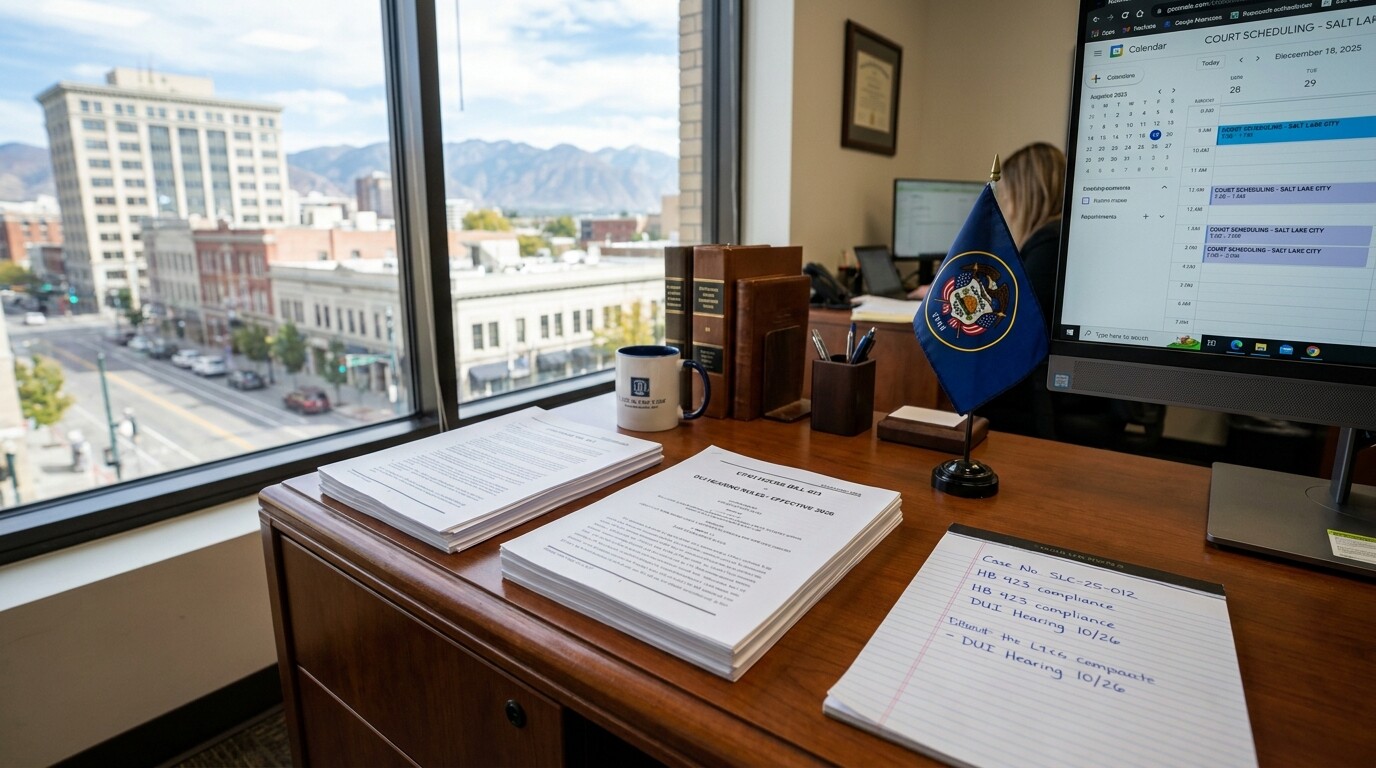
A new Utah DUI bill moved forward in late February 2026, affecting anyone arrested in or around Salt Lake City. On February 26, 2026, the Utah Senate Judiciary, Law Enforcement, and Criminal Justice Committee considered 2nd Sub. H.B. 423, titled Hit and Run and DUI Offense Amendments, sponsored by Rep. Steve Eliason. During that hearing, family members connected to fatal cases testified in support, and the committee replaced the second substitute with a third substitute before voting to pass it out favorably. (utleg.gov)
For anyone facing a DUI accusation, the headline is both political and practical. Utah already has some of the strictest DUI rules in the country, including the nation’s 0.05% BAC limit for drivers 21 and older, and legislative changes can affect how prosecutors, courts, and the Driver License Division handle these cases. (highwaysafety.utah.gov)
Why HB 423 matters in a dui first offense Utah case
Utah DUI law creates significant pressure on first-time defendants. A first arrest triggers both a criminal court case and a separate administrative process through the Driver License Division. The DLD handles license consequences, while the court handles the criminal case in the county where the arrest occurred. (dld.utah.gov)
This split system makes legislative developments critical. Before any courtroom outcome, a driver may face hearing deadlines, suspension exposure, ignition interlock issues, and questions about whether the stop, field tests, or chemical testing can be challenged. Utah’s Driver License Division requires a person arrested for DUI to request a hearing within 10 days of arrest and may continue driving for 45 days from the arrest date before privileges may be withdrawn. (dld.utah.gov)
Capitol news quickly becomes a real-world problem in Salt Lake City. If lawmakers revise DUI and hit-and-run penalties or procedures, people researching a dui first offense Utah situation need to understand both what the bill says and how aggressively existing laws are already enforced. Defense analysis focuses on deadlines, proof problems, procedural safeguards, and whether the government can establish guilt beyond a reasonable doubt.
The Utah baseline every driver should know
Utah starts from a stricter baseline than almost every other state. The Utah Highway Safety Office says Utah is the only state where the prohibited BAC for drivers age 21 and older is 0.05% or higher. Even a first-time arrest can begin from a lower alcohol threshold than many drivers expect. (highwaysafety.utah.gov)
Administrative penalties are serious from day one. For drivers age 21 and older, the DLD lists a 120-day suspension for a first per se arrest and an 18-month revocation for a chemical-test refusal. For a second or subsequent offense, the periods increase to 2 years for a per se arrest and 36 months for a refusal. (dld.utah.gov)
A DUI conviction creates consequences beyond the initial suspension. Utah’s DLD says an alcohol DUI conviction brings ignition interlock restrictions for 18 months for drivers 21 and older and 3 years for drivers under 21. (dld.utah.gov)
A Salt Lake City example that shows how fast the pressure builds
Imagine a 29-year-old Salt Lake City professional pulled over after dinner in Sugar House and arrested on suspicion of DUI. It’s their first arrest, and they leave jail thinking the main issue is the court date. In reality, the clock is already running on the separate DLD hearing request, and waiting can create avoidable damage to driving privileges. (dld.utah.gov)
Now add the uncertainty created by a bill like HB 423. The person sees headlines about tougher DUI legislation and assumes the state has all the leverage. But a defense-minded review asks different questions: Was the traffic stop lawful? Were roadside observations recorded accurately? Was the breath or blood testing process handled correctly? Was the arrest report internally consistent? Those questions still matter, whether the case involves a dui first offense Utah charge or something more serious.
That’s the key point many people miss in the first week after arrest. New legislation can change the environment, but it doesn’t erase constitutional protections, evidentiary weaknesses, or the prosecution’s burden of proof.
What happened at the Capitol on February 26, 2026
The February 26 committee hearing gave the bill a human and political frame. According to the Utah Legislature’s committee timeline, Rep. Steve Eliason presented 2nd Sub. H.B. 423 with assistance from Brad VanOrman, father of victim Lindsey VanOrman, and Glendon Mitchell, grandfather of victim Eli Mitchell. Jeremy Mitchell, Eli Mitchell’s father, also spoke in support. (utleg.gov)
The committee made a procedural change. Sen. Musselman moved to replace HB0423S02 with HB0423S03, then moved to pass HB0423S03 out favorably. Anyone trying to understand the bill’s effect should rely on the latest substitute version. (utleg.gov)
The bill’s title changed as it moved through the process. A Utah legislative committee report from February 12, 2026 shows that H.B. 423, originally labeled DUI Offense Amendments, was replaced and favorably recommended as 1st Sub. H.B. 423, Hit and Run and DUI Offense Amendments. (pf.utleg.gov)
Why the hearing context matters to the defense side
Legislation driven by tragic facts often creates momentum for tougher laws. That’s understandable politically, but in an individual case, courts still must apply the law to the specific evidence. Sympathy for a bill’s purpose is not proof that every future DUI arrest was lawful or that every test result is reliable.
That distinction matters especially in a dui first offense Utah case. First-time defendants often assume they should plead quickly because the state’s system feels overwhelming. But the smarter approach is usually to understand the separate DLD and court tracks, preserve deadlines, and evaluate the prosecution’s evidence before making permanent decisions.
The immediate defense issues after a first Utah DUI arrest
The first urgent issue is usually the license side, not the final criminal outcome. Utah’s DLD says a person arrested for DUI must request a hearing within 10 days and may keep driving for 45 days from the arrest date unless action is taken. Missing that window can change the case posture fast. (dld.utah.gov)
The second issue is evidence preservation. In many DUI cases, the most important facts involve the basis for the stop, bodycam or dashcam footage, the sequence of field sobriety testing, the wording of implied-consent warnings, and the collection or handling of breath or blood evidence. These issues can become harder to reconstruct over time.
The third issue is understanding how Utah’s newer license-related rules may interact with an arrest. The DLD’s DUI page links to Utah’s new interdicted-driver law effective January 1, 2026, showing that the state’s DUI-related licensing system continues to evolve. (dld.utah.gov)
Practical points Salt Lake City drivers should keep in mind
A measured response in the first days after arrest can matter significantly. Useful early priorities often include:
- Requesting the DLD hearing quickly if the deadline is still open
- Identifying all upcoming court and license dates
- Preserving receipts, witness names, and location details
- Asking for available reports, videos, and testing records through proper channels
- Avoiding assumptions that a first arrest automatically leads to the same outcome in every case
None of these steps guarantees a result. Outcomes depend on the facts, the evidence, the procedural history, and the law that applies. But acting early usually gives a driver more room to protect driving privileges and evaluate defenses.
How recent Utah guidance shapes first-offense expectations
Official Utah materials show that first-time DUI allegations carry serious collateral consequences even before final resolution. The DLD’s DUI information explains the two-track system, the 10-day hearing deadline, the 45-day driving window, and ignition interlock restrictions after conviction. (dld.utah.gov)
The phrase dui first offense Utah can be misleading if read casually. "First offense" may sound minor, but Utah law treats it as a significant event with both criminal and licensing consequences. And because Utah’s BAC threshold is 0.05%, some drivers are charged at levels that wouldn’t trigger a per se DUI charge in many other states. (highwaysafety.utah.gov)
Readers who want broader background on Utah DUI defense issues can review Utah DUI defense topics for general information. For ongoing legal updates and commentary, recent Utah legal updates can also help place new developments in context.
Public sources are useful for confirming the state’s current framework. The Utah Driver License Division’s DUI information page outlines the hearing deadline, drive-time window, and administrative-versus-criminal split, while the Legislature’s committee hearing page is the type of source readers should check when tracking fast-moving bill activity. (dld.utah.gov)
How Does This Impact Me?
What does this bill mean for my current case?
The legal landscape may be changing, but it doesn’t automatically decide your case. A pending bill can influence future penalties or procedures, yet your case still turns on the actual evidence, the date of the alleged offense, and which version of the law applies. Separate media coverage from the specific facts in your file.
Does this change my 10-day DLD deadline?
The 10-day hearing deadline still matters immediately after arrest. Utah’s DLD says a driver arrested for DUI must request a hearing within 10 days of arrest. If a deadline has passed, a late request may still be submitted with an explanation, but that doesn’t guarantee approval. (dld.utah.gov)
If this is my first DUI arrest, am I definitely losing my license?
Not necessarily, but the risk is real and time-sensitive. The administrative side and the criminal side are separate. The DLD lists a 120-day suspension for a first per se arrest for drivers 21 and older, with harsher consequences for refusals. Whether that happens depends on hearings, evidence, and the path the case takes. (dld.utah.gov)
What if I refused a breath or blood test?
Refusal allegations create steeper administrative exposure. Utah’s DLD lists an 18-month revocation for a first refusal and 36 months for a second or subsequent refusal for drivers 21 and older. That makes early case review especially important, including whether implied-consent procedures were followed correctly. (dld.utah.gov)
What should I do next if I was arrested in Salt Lake City?
Focus first on preserving your options, not on making assumptions. Confirm the arrest date, identify the DLD deadline, keep all paperwork, and review the case for stop, testing, and procedure issues. This article provides general information only, not individualized legal advice.
What this means for Salt Lake City drivers going forward
HB 423 is a reminder that Utah DUI law is not standing still. As of February 26, 2026, the bill had moved through a Senate committee after testimony from victims’ family members and after substitution from the second to the third substitute version. Meanwhile, the core realities of a Utah DUI arrest remain unchanged: strict BAC rules, a fast DLD timeline, separate administrative and criminal exposure, and meaningful consequences even in a first case. (utleg.gov)
For people in Salt Lake City, the practical lesson is simple. If you’re facing a dui first offense Utah accusation, treat the situation as urgent, gather accurate information early, and make decisions based on actual evidence rather than fear. If your situation may be affected by this recent development or you need more information about Utah DUI procedures, Nix Law is available as a resource. You can call 385-444-2442 or contact us today to discuss your situation further.