New Scrutiny for K-9 Drug Stops and the Utah Good Samaritan Overdose Law
Key Takeaways: K-9 alert searches during fentanyl traffic stops in Salt Lake City sit at the intersection of federal and Utah constitutional protections. Defense attorneys often challenge drug-dog reliability, stop duration, and whether officers had genuine probable cause before a vehicle search. A major empirical study of Utah warrants has renewed questions about how carefully judicial review actually works. Utah’s Article I, Section 14 can, in some cases, offer broader protection than the Fourth Amendment alone. Understanding how the utah good samaritan overdose law and search-and-seizure doctrine interact may matter when overdose-related stops lead to charges. Outcomes always depend on the specific facts of each case.
A routine traffic stop can turn into a felony fentanyl case in the time it takes a police dog to circle a car. For drivers in Salt Lake City and across Utah, the moment a K-9 "alerts" is often when a minor stop becomes a search, and a search becomes a charge. Recent legal scholarship examining how Utah courts review search and seizure practices has given defense attorneys fresh reason to question whether that process is as rigorous as many assume. That development matters to anyone whose vehicle was searched after a dog sniff, because the strength of a probable cause defense can shape the entire case.
The Constitutional Backbone of a K-9 Alert Search Defense
The starting point for any K-9 alert search defense is the constitutional command that searches and seizures must be reasonable. The first clause of the Fourth Amendment requires that a search or seizure not be "unreasonable," described as the fundamental command of the Amendment. This standard governs what officers must justify before extending a stop or searching a vehicle. Reasonableness is not a rigid formula, and courts weigh it case by case.
Utah drivers enjoy a second, independent layer of protection under the state constitution. Utah’s charter protects against unreasonable searches through language you can review in the text of Article I, Section 14, which conditions any warrant on probable cause supported by oath and a particular description of the place to be searched. Americans generally enjoy two layers of constitutional protection: one enshrined in the federal Bill of Rights and the other in a state constitution. This "double security" framework gives defense counsel two distinct grounds to argue for suppression.
Importantly, Utah courts have not always treated the state provision as identical to its federal counterpart. Utah courts have in some cases provided broader search protections than federal law. That means a search that might survive a purely federal challenge could, under certain circumstances, still be contested under Section 14. Because this area is fact-sensitive and evolving, results vary from case to case.
Why New Warrant Research Matters for Fentanyl Traffic Stop Utah Cases
A recent study has cast doubt on the assumption that judicial oversight of searches is consistently thorough. Legal researchers noted that surprisingly, we know almost nothing about how the Fourth Amendment regulates searches and how searches actually work in practice. That gap is significant because much of the criminal justice system presumes careful review at each step.
The research is grounded in Utah data, which makes it directly relevant to Salt Lake City stops. In the Harvard Law Review analysis titled Unwarranted Warrants, the authors state they analyze over 33,000 warrant applications filed through Utah’s "e-Warrants" system over a three-year period. Related coverage of the study examined those applications submitted between 2017 and 2020, with findings on the speed and thoroughness of warrant review. For a defendant, data suggesting that review can be quick may support arguments that a warrant flowing from a K-9 alert deserves closer scrutiny.
This does not mean every warrant is defective, and courts interpret suppression remedies narrowly. The value of the research lies in giving defense counsel a data-informed basis to probe how a particular warrant was reviewed. Whether that argument gains traction depends heavily on the record in each case.
A Salt Lake City Scenario: When a Sniff Becomes a Search
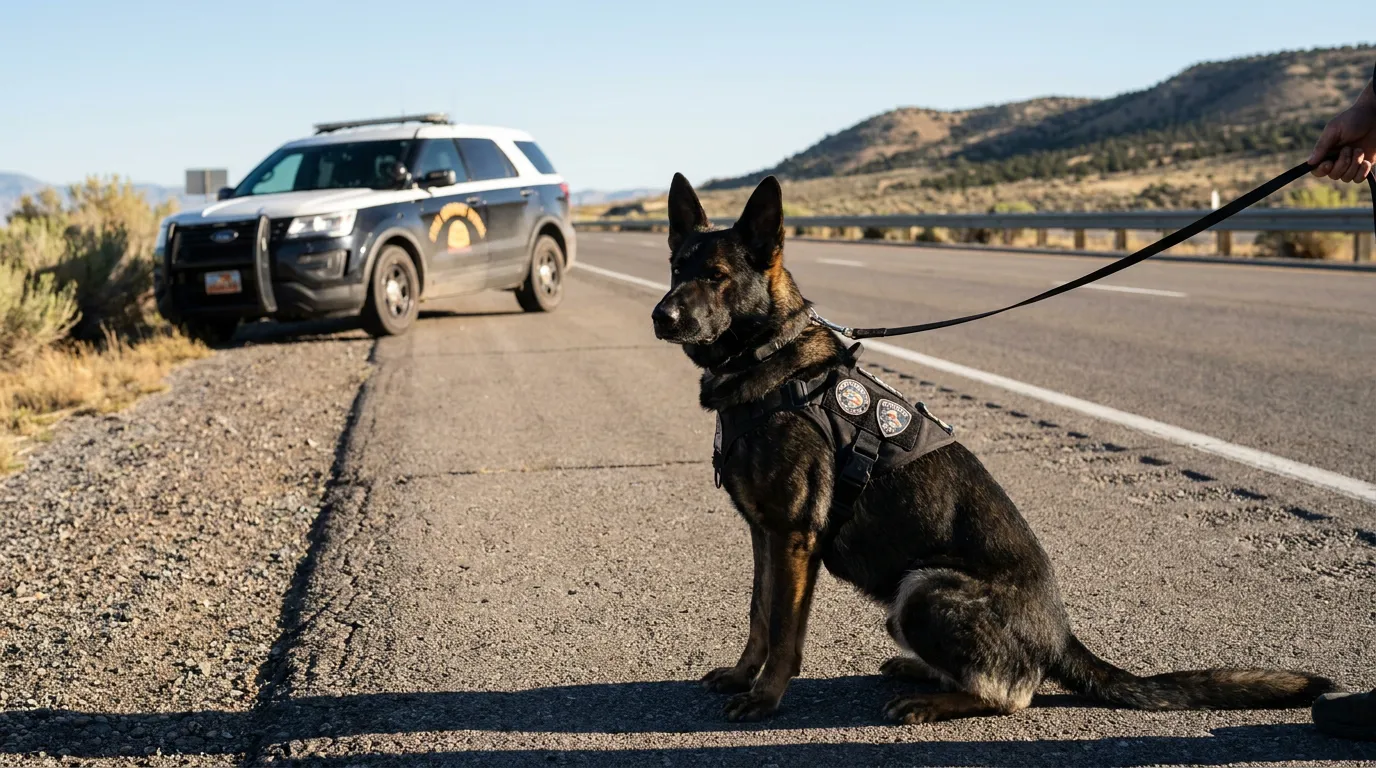
Consider a driver heading home on I-15 who is pulled over for a minor lane change near downtown Salt Lake City. The officer runs the license, then keeps the driver waiting while a K-9 unit is called. Minutes pass, the dog circles the car, and the handler reports an alert. Suddenly the driver faces a full vehicle search and, ultimately, a fentanyl possession charge.
In this situation, several defense questions immediately arise. Was the stop unlawfully prolonged beyond its original purpose? Did the dog have a documented reliability record, or a history of false alerts? Was there genuine probable cause before the search began? Each of these is a potential pressure point in a Fourth Amendment vehicle search analysis, and each turns on specific facts that a careful review of the record may reveal.
Common Ways Attorneys Challenge Drug Dog Reliability and Stop Duration
Defense strategies in these cases generally focus on the moments before and during the search. Because the Supreme Court has recognized that officers may sometimes act without a warrant, the analysis often centers on whether an exception truly applied. Indeed, the Supreme Court has interpreted the Fourth Amendment to allow exceptions to the warrant requirement. Counsel scrutinizes whether the facts actually fit one of those recognized exceptions.
Attorneys frequently examine the following issues when building a challenge:
- Stop duration: whether officers extended the stop beyond the time needed for the original traffic purpose.
- Drug dog reliability challenge: the animal’s training records, certification, and false-alert history.
- Handler cues: whether the handler may have unintentionally signaled the dog to alert.
- Probable cause defense: whether the totality of circumstances genuinely supported the search.
- Chain of custody: how any recovered substance was collected, stored, and tested.
These arguments connect to the broader question of when police may search a car at all. Readers weighing their options can learn more about warrantless vehicle searches in Utah drug cases and how those rules apply to roadside stops. The key point is that reasonableness reflects a deliberate balance, one the framers built in because searches, in their view, "should be slowed down." Whether a court agrees that a particular search moved too fast is a fact-dependent inquiry.
Where the Utah Good Samaritan Overdose Law Fits In
The utah good samaritan overdose law is worth understanding alongside search-and-seizure defenses because overdose situations can generate police contact. When emergency calls or medical events lead to a stop or vehicle search, the resulting drug charges are typically prosecuted under Utah’s Controlled Substances Act. Under that statute, it is unlawful to knowingly and intentionally produce, distribute, or possess with intent to distribute a controlled or counterfeit substance. Fentanyl cases can also implicate a separate trafficking provision, so the exact charge matters.
Even where a Good Samaritan protection may apply to certain overdose reporting, it is generally limited to lower-level offenses such as simple possession or paraphernalia and typically does not extend to distribution or trafficking charges, nor does it automatically resolve an unlawful search question. These are distinct legal issues, and courts consider them separately. A person may still need to challenge how evidence was gathered, regardless of whether an overdose-reporting protection is raised. Anyone facing these overlapping issues may benefit from tailored guidance on Drug Crimes in Salt Lake City rather than assuming any single protection controls the outcome.
How Does This Impact Me?
What Does the New Warrant Research Mean for My Case?
The research suggests judicial review of searches may sometimes be less rigorous than assumed. For your case, that could support a closer look at how any warrant or search flowing from a K-9 alert was justified. Whether such an argument helps depends entirely on your specific facts and the evidence in the record.
Can a K-9 Alert Alone Justify Searching My Car?
In many cases, a reliable alert can contribute to probable cause, but reliability is not assumed. Courts may consider the dog’s training, certification, and error history when evaluating a search. If the stop was unlawfully prolonged before the sniff, that timing issue can also be central to a suppression motion.
Does the Utah Good Samaritan Overdose Law Protect Me From Charges?
The utah good samaritan overdose law addresses certain overdose-reporting situations, but it is not a blanket shield against all drug charges. Its protections apply only under specific conditions, generally cover offenses such as simple possession rather than distribution or trafficking, and often take the form of immunity or an affirmative defense that courts interpret according to the statute’s text. A search-and-seizure defense may still be necessary even where a Good Samaritan issue is present.
What Should I Do After a Fentanyl Traffic Stop?
Preserving your rights early can be significant. Avoid discussing details of the stop publicly, and gather any information about the timeline and the officers involved. Speaking with a fentanyl possession attorney promptly may help protect potential challenges before deadlines pass.
Is Suppressing Evidence in Utah Guaranteed if the Search Was Improper?
No outcome is guaranteed, and courts apply suppression remedies narrowly. Even a questionable search does not automatically lead to dismissal, because judges weigh the full context. A motion to suppress evidence in Utah must be supported by a well-developed factual and legal record.
Protecting Your Rights After a Roadside Fentanyl Search
The renewed attention to how Utah reviews searches underscores a practical truth for anyone stopped on the road. Constitutional protections against unlawful search and seizure in Utah exist on both the federal and state level, but they generally must be actively raised and argued. K-9 alert cases turn on timing, documentation, and probable cause, and each of those elements can be examined in detail. Because every stop is different, the strength of any defense depends on the specific circumstances involved.
Understanding these issues is the first step, not the last. The interplay between the Controlled Substances Act, the utah good samaritan overdose law, and search-and-seizure doctrine can be complex, and the analysis is highly fact-dependent. This article is general information and not individualized legal advice.
If you or a loved one is facing charges after a K-9 alert search, Nix Law is available to discuss how these developments may affect your situation. Call 385-444-2442 or contact us today to learn more about your options.